Thursday, May 29, 2008

Free Independent Film Financing Seminar (in Los Angeles)

Independent Film Financing 101
Sunday, June 8th at 5:45 p.m.
at Filmmakers Alliance
1030 W. Hillcrest Blvd.
Inglewood, CA 90301

Independent Producer Suzanne Lyons will present perhaps the most valuable single seminar for emerging filmmakers looking to raise financing for their feature films. She will paint a comprehensive, REALISTIC picture of the independent film financing landscape, answering such important questions as:

- What are the typical sources of film financing for emerging filmmakers?
- How do filmmakers find private equity investors and what is the best way to approach them?
- What is the importance of a business plan and what should it include?
- How do filmmakers set up a proper and legal entity for soliciting and receiving film investments?
- Are there people or producers (because they are rarely the same thing) or maybe even agents and lawyers that will raise money for an emerging filmmaker? How do you find them? What kind of deal do you make with them?
- Is it possible for emerging filmmakers to get funding from established production companies or sales agents?

If you are planning a feature and can't (or don't want to) pay for it with your life savings or credit cards and don't have big studios lining up to finance your film, then you MUST attend this seminar.

Photobucket

Suzanne Lyons co-founded Snowfall Films, Inc. and WindChill Films, Inc, and in just seven years has produced or executive produced eight movies. Suzanne has worked with wonderful talent over the years, including Brenda Blethyn, Christopher Walken, Naomi Watts, Alfred Molina, James Caan, Dean Cain, Jennifer Tilly, Jon Lovitz, Asia Argento, Winona Ryder, Peter Fonda, Adrian Paul and more. Her budgets have ranged from the SAG ultra low $200,000 to $7.5 million. Her films have won a gamut of awards and festivals from the prestigious British BAFTA award, a premier at the Directors Fortnight at the Cannes Film Festival, best picture at Shockerfest and acceptance into the Toronto, Berlin and Montreal Film Festivals. Her films have been distributed by Miramax, Screengems and Lionsgate.

What’s next on her slate for WindChill Films is a project called MOST LIKELY TO… and for Snowfall Films Suzanne will be producing her suspense thriller A.K.A. scheduled to shoot in Germany this fall, a Mark Smith thriller HARDCOURT and an animated Christmas special OMARR THE CAMEL.

Suzanne is also co-founder of the Flash Forward Institute and has led hundreds of industry seminars in both the US and Canada to well over 15,000 participants. She is currently leading a workshop on Low Budget Filmmaking and the next workshop is scheduled for this fall on the weekend of October 18th.

To contact Suzanne regarding information on the fall Workshop please call the Snowfall Films’ office: 818-558-5917

Tuesday, May 20, 2008

Acting Coaches and Classes

I ain't no damn actor, that's for sure. I don't even like actors, for the most part. Although I admit to finding them consistently entertaining, their all-consuming self-absorption eventually becomes maddening and wearisome even with the most well-adjusted of them.

On a creative level, however, I am constantly in awe of them - amazed by what they do and how they do it. And deeply appreciative of what they bring to a film. So, when I cross paths with a truly talented actor, I treat them like the creative treasures that they are (just as I would a brilliant writer, d.p., editor, etc.). And when I meet actors with all the right raw materials, I am eager to hook them up with acting coaches and/or classes that will help refine their gifts and bring out the best of their raw talent.

I know there are many people who don't believe in acting classes and some who feel, in fact, that they interfere with their own organic process. If those people are brilliant, I agree with them. If not, they are morons. I personally believe, since great acting roles are few and far between for most actors, almost any opportunity for an actor to explore their art/craft is a good one. However, I do agree that there are some acting schools that can do far more damage than good to both an actor's art and their personal mental/emotional health.

But even among acting school proponents, there are many divergent schools of thought around acting - each with their own solar system of acting schools. Of course I have my own specific ideas about acting and they articulated and taught beautifully by two of my favorite acting coaches/classes -given by Shawn Nelson and Deb Lemen.

SHAWN NELSON
Photobucket

DEB LEMEN
Photobucket

One of the things I love most about these two is not just what they do for actors, but also what they can do for filmmakers. Both of them work with filmmakers and help them understand what constitutes great acting and how to best bring it out of their actors. They also help filmmakers understand the actor's various processes and dilemmas so that they can COMMUNICATE effectively. Yes, communication is key in working with all of the members of your creative team. But communicating with actors takes a special kind of understanding, insight and skill because what and how you communicate with them can dramatically impact their performance. And although you can mostly hide it when any other crew member isn't bringing their "A" game, it's very tough to hide with actors.

Yes, I took their classes. And yes, I confirmed for myself why I am not an actor and why I would never want to be an actor. It also further put me in awe of what actors are capable of doing and and helped to build a bridge of understanding as to why they are such freaks on a personal level. I am constantly astonished by the seemingly endless emotional well from which actors are able to draw their performances. And in the hands of strong coaches/classes such as Shawn and Deb, they can bring deeply nuanced new levels of complexity, impact and intelligence to even the most minor of roles.

Thursday, May 8, 2008

Spring Cleaning at FA...and beyond...

A couple of weeks ago, we did some Spring Cleaning here at FA. And it feels really good. Stuff we've dragged around for years got moved out - sold, given away, donated to charity or simply thrown out. The psychic/spiritual lifting of burdensome, and even oppressive, energy has naturally lead to embracing this Spring Cleaning as an appropriate metaphor for so much else that needs to happen in my life and mind.

It's amazing what we've been able to dig out of the nooks and crannies of our office. Equally amazing that it ever made it to this office at all given the number of times we've moved. But of course, so much of the stuff has ties to memories that have lead me to the nooks and crannies of my own mind. And in there is definitely a lot of junk there - along with some threads of gold that need to be spun into something creatively fulfilling.

However, it is not as easy to remove the junk from your brain as it is the junk in our office. Once it's is gone from the office, it is gone, never to be seen again. But mental/emotional baggage just goes underground and pops up at the most annoying times and informs your life in, sometimes, the most inconvenient ways.


FA JUNK
Photobucket


JACQUES' BRAIN
Photobucket


Nonetheless, buried thoughts and obsessions are some of the best things to mine for story ideas and character detail. The things that lodge in your brain and refuse to leave can torture you personally, but enrich you creatively. And perhaps, that creative process may purge you of this otherwise useless psychological garbage dump. At the very least, it may allow us to shed light on these obsessive thoughts, habits and perceptions and maybe shift the balance of power around them. Meaning, rather than guiding our actions, they are servicing our creativity.

Or not. I've seen some creative types who simply spin deeper into their obsessions when they externalize them creatively. Their filmmaking then becomes fetishistic - which can be really compelling to a point. But real art is not fetishism. Real art, to my mind, has a level of observation, clarity and (for lack of a better word) truth that makes fetishistic creativity seem like passing fancy.

Either way, better to dig into the nooks and crannies of your brain and make use of what's there even if you insist on keeping it and/or fetishizing it. How do we do this? Through simple observation and awareness - which is not so simple for some people. They are plagued with so much self-loathing and self-judgement that they cannot even begin to look at themselves lest they generate all kinds of hateful opinions about what they see. Don't get me wrong, creatives are often as self-loathing as they come, but rather than simply sit with that energy, we are driven to explore it and, often, integrate it into our work - as well as the things that we believe generate that self-loathing.

I, for one, find I have so many odd neuroses and strange thoughts that I most certainly would have been straight-jacketed years ago if I hadn't found a way to make those things a compelling element of my dinner conversations....and, of course, my filmmaking.

In the end, Spring Cleaning literally and metaphorically is less about purging all your junk than it is about simply throwing open all the closets, cabinets, hidden drawers and trap doors and taking stock of what's there. If you occasionally do that with your mind, you will find, like we did at the FA Office, there is much of value hidden away there. The things that once weighed you down psychologically, can lift you up creatively.

Tuesday, May 6, 2008

The Courage and Ego To Be Bad

On Monday, FA is hosting another screening at the Echo Park Film Center. We love the people, purpose and programs of the Center and do 4 to 5 screenings a year there. Often, we show select FA films and other inspired and inspiring works from LA-area filmmakers.

But this Monday, we are offering up a different kind of inspiration. We are calling it "FA's First and Worst". It is a selection of films made during FA's first few years in existence. And believe me, much of this work is excruciatingly bad.

So, what is to be gained by exposing an audience to such abysmal cinema besides self-mocking hilarity? Perhaps nothing. Self-mocking hilarity is pretty fun all by itself. But what I also hope the screening will do is inspire other filmmakers.

Inspire? Where is the inspiration in films that are poorly shot, poorly acted, poorly written, poorly sound-recorded and in all other ways a poor excuse for filmmaking? Well, first of all, they were made when so many potential films simply are not. Of course, there is a strong argument to be made that this is not a good thing. But I argue that any film made is a good thing. Every filmmaker needs to start somewhere. Every filmmaker needs to explore their craft and artistry. And, as I've said elsewhere, in that exploration, they need to be willing to fail. And to actually fail. Often. There is no reward without risk. And there is no risk without failure (unless you are absurdly lucky). Failure, for lack of a better word, is a necessary part of the evolutionary process. The problem isn't in the making of bad films. It is in the showing of them. Which is why we don't often show these films and why we are making no bones about the "quality" of this screening.

The other reason we are showing the films is as a measuring stick of, not just FA's, but each filmmaker's individual growth. A few of us have become fairly accomplished filmmakers - but you might not guess it possible from the work we'll have on display. But how do some filmmakers evolve (while others do not)? How do they find their creative voice and develop the filmmaking skill to make that voice sing?

By having the courage to be bad...and/or the ego. Yes, I say courage. Because it demands exactly that to face the blank page or a surly film crew armed with an idea that is rarely flawless. But where courage fails, ego steps in. Dreams of glory or an over-inflated self-importance can also push us forward, allowing us to take the necessary risks in our own creative evolution. To risk failure.


But that is only half of the equation. The other half is being able to eventually look at the filmic creation you've realized with the cold, objectivity of an IRS accountant (minus the self-loathing bitterness, perhaps, although that is often hard to escape). And from that, learn and grow. This may take some time as the fearless ego that may have helped push you forward, now becomes an emotionally fragile, but psychologically combative resistance fighter - protecting the fantasy you have of your work from the reality of it. Using the ego to push you forward sometimes feels like borrowing money from the mob. It gets you through your immediate difficulty, then presents inextricable difficulties of its own down the road.

But ego is a reality in our process. Let's face it, ALL creative beings have a monstrous ego of some sort. Yes, there can be raw, artistic courage in us, but there is usually a healthy dose of ego, as well. Therefore, managing that ego is key to creative growth. Luckily, you can use one kind of ego against another. Meaning the kind of ego that fuels creative ambition will eventually steamroll over the fragile ego that wants everyone to like your work and , therefore, holds you a prisoner from your creative development.

But the desire to do great work can also be a "calling" that is much more than ego and even something more than courage. I won't even try to explain it other than to say I believe it is what separates truly visionary filmmakers from merely competent ones. But even filmmakers who have been "called" to do great work must go through the evolutionary process. Have you seen any of Scorcese's or Coppola's very first student shorts? Or stuff they did with friends even before that? At some point, the simple desire to make any kind of film and the ego that begged for people to like it was supplanted by something stronger - part ego, part calling - that drove them toward the type of work that distinguishes them as truly great filmmakers.

Now, of course, there are filmmakers who never challenge their own work and continue to make bad films. Luckily, If they are bad enough, they have genius of their own. And there are filmmakers who simply do not have the raw materials and/or artistic perspective to be great filmmakers, and all of their creative ambition will never make them more than competent filmmakers. But is that so bad? All of us will eventually reach the peak of our own potential if we keep making films and, in the process, risk failure, risk making bad films.

But filmmakers don't need to show these films to anyone other than those who will love them unconditionally.

But we do. And we will wear our incompetence like a badge of courage...and hopefully filmmakers will take inspiration from it....and much hilarity.

Tuesday, April 29, 2008

What is a Filmmakers Alliance Film?

People often ask what constitutes a Filmmakers Alliance (FA) film. The short answer is any film that is made by an FA member is an FA film. But clearly, people have seen a preference at work when we make selections for events like VisionFest or a public screening at Echo Park Film Center. So, to clarify our preferences and priorities, here's the 5 key elements the film must demonstrate for it to be considered an ideal FA film:

1. FA Film Status
Literally, the film must have been made by an FA member while they were members of Filmmakers Alliance.

2. A Personal POV and/or an Original Voice
Is this a film that could have only been made by this filmmaker? Does this film reflect an aesthetic approach, ideas and/or a view of the world that are unique to this filmmaker? Does this film explore an issue or comment on the world or an aspect of life as the filmmaker sees it and experiences it?

Original voice is the sum of many unique literary, visual, aesthetic choices or interpretations the filmmaker utilizes to express their PERSONAL POV. Original voice can also be the bold interpretation or reinterpretation of what has come before. Does the filmmaker have a unique way of expressing her/his ideas through an innovative use of genre or tone? Does the film have a unique visual style, sound design, etc. that effectively underscore and communicate the thematic elements?

3. Respect for the Craft of Filmmaking
Does this film demonstrate a level of accomplishment in the craft of filmmaking and some level of mastery of film language in the areas of production design, lighting, camera, continuity, sound design, acting, pacing, editing, signifiers, metaphor, dialogue, tonal consistency, etc.?

4. Appreciation for the Art of Filmmaking
Does the film work on many levels – visual, aural, spiritual, intellectual and/or as entertainment? Does the filmmaker appear to have an awareness and understanding of what has come before as far as the history and language of cinema?

5. Respect for the Collaborative Energy of Filmmaking
Was the pre-production, production, and post-production process positive and inclusive? Does the filmmaker graciously acknowledge and honor the contributions of others?

Now, I recognize that all of this sounds like we are only interested in SERIOUS ART. Yes, we are indeed very much interested in creatively ambitious cinema, but even broad comedies and genre films can be made according to these guidelines. In fact they SHOULD be made according to these guidelines if you want to do something singular and therefore memorable. If you are going to lay your heart, soul and ego on the line (not to mention your bank account) to make films, why not aspire to to the highest level of your own creative potential. A failed "Annie Hall" will always be 10 times more interesting and compelling than a thousand successful "American Pie"s. And, there may be a thousand of them before the studios are done. It's FA's goal to provide some small counterbalance to that sad fact....

Friday, April 25, 2008

OUR FILMMAKER'S AND WRITER'S RETREAT

My former wife, Diane Gaidry, conceived of the project "Red, White and Blue" - an homage to Krystof Kieslowski's decalogue that put together 10 FA filmmakers who each would create a tangentially-connected short elliptically addressing one of the American Bill of Rights. Brilliant, timely idea for which, sadly, we still have yet to find the financing. I am one of the filmmakers, and in developing the project, Diane conceived of a creative retreat, where the participating filmmakers would work on their individual projects, share ideas, watch/discuss films and bond socially in a quiet, but intensely focused setting. We did a few of them and they were all terrifically productive and inspiring. Fun, too.

So, even though "Red White and Blue" has stalled, there are still plenty of other projects that we all have in various stages of development/completion. So, we decided to continue the retreats. But they would be built along the idea that each of us woudl be doing our "own thing" without any connection to the others - our own projects in our own way. But all else would be the same - a beautiful, serene, fairly remote location. A big house that would fit us all. Community meals and a strict creative schedule - but with some time for play. Of course, all of the participating filmmakers would chip in for the cost of it - roughly $220 per person for a three-night retreat with everything (lodging, food, booze, firewood, toilet paper, etc.) included.
Photobucket
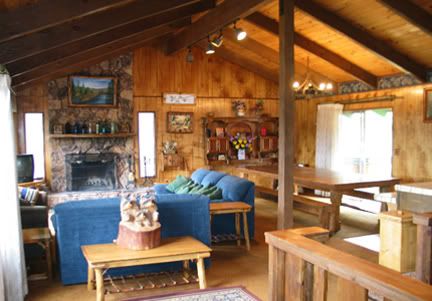
OUR LOVELY CABIN WITH A TABLE BIG ENOUGH TO FIT ALL OF OUR EGOS AND DRAMAS

So, we did one just this past week-end. And I can't help but take the time to talk about what a great experience it is and sort of break down why this sort of thing is so nourishing for certain kinds of filmmakers - or any creative beings. I say certain kinds because there are many creative-types who do not thrive in a group environment. They rail against it. The do not need nor want community involvement in the creative process and feel such energy is a threat to their own methodology. I can understand that. The creative process should invite risks and failures. It can also dig deep into highly vulnerable personal spaces. It can excite the sensitivity of our egos in ways we never expected. It's easy to see how laying this all out - sometimes prematurely - in a group dynamic can be very unpleasant.

But personally, I thrive on it. Even in the very earliest stages of a project. Part of it is bravery (my own little self-congratulatory opinion) and part of it is insecurity. I am indeed fearless about laying it all out there and letting people see the blemishes and turds that are part of the creative process. But that fearlessness comes in part, from a sense that I don't have what it takes to do it alone. And when I say I don't have it, I don't mean talent and ideas - although I'm happy to suck those out of anyone who'll let me. I'm talking about objectivity. Sometimes, I get so bonded with my own creations or I am so obsessed with a particular image or thematic that it's almost impossible for me to let it go...to see that it is simply not working.
Photobucket
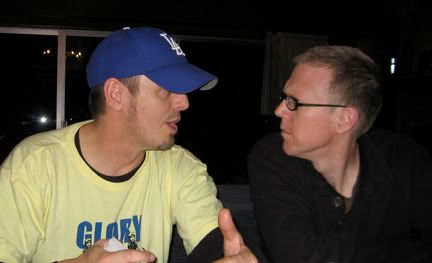
CAIN DEVORE LETS SEAN HOOD KNOW PRECISELY WHY HE THINKS HIS SCRIPT IS BETTER THAN SEAN'S

I also like how communal reactions and ideas stimulate my own. I've been given some ideas that are admittedly horrible ideas (even by the person giving them) that have spurred all kinds of great new things for me. I have had the entire room tell me how bad an idea is in a way that confirmed for me just the opposite - how good the idea is. Because they are reacting exactly how I need them to react so that I know that the film is on the right path of the journey I am taking them on.

And, finally, it is always inspiring and stimulating to learn from others' work and from my own reactions to it. Reading and reacting to other work always challenges or clarifies things for me in my own work or in regard to general filmmaking aesthetics. Why did you make this or that choice with the character? How are you choosing to explicate this or that theme? Why was I not compelled by this script 30 pages into it, yet when I finished it, felt completely satisfied - even deeply moved? Asking these kind of questions of myself and the filmmaker almost always leads me to a greater understanding of what makes a film work.

So, here's how it went - just in case you want to create your own. Pretty simple:

- Gather up eight to twelve talented, articulate, creatively ambitious filmmakers who have the time and money to do this, but who also have a project they are actively working on and, on which, they need support. This is the toughest part by far, obviously, for most of you. But thankfully, not for us in our little FA family.

- A week-end usually works best, depending on people's lives and jobs, but it typically needs to be two full days and two half days. Meaning, participants come in Friday afternoon and leave Monday morning. If necessary for their jobs, people can come in late Friday and leave late Sunday night. Can feel a bit rushed, but it works.

- Find a place in a beautiful, serene setting that is big enough to house all of you comfortably. We went to Big Bear this time, but in the past, had also gone to the Central Coast Wine Country and other places. We found the cabins and made the reservations online. Remember, unless you all have big bucks, you may need to share rooms. Ours had 5 bedrooms with twin and bunk beds. Worked out nice. You also need a good-sized living room to meet and discuss.

- We invited people to submit whatever they were working on which could include short and feature-length scripts, partial feature length scripts, treatments, proposals and film rough cuts. It really can be anything that needs work and can benefit from a communal feedback process.

- All of the projects need to be reviewed by all of the participants prior to the retreat. That means participants need to submit copies of their projects to all of the other participants no later than one week prior to the retreat. They must be ready to give their feedback on each project in a clear, constructive way.

- Someone will have to pay for the cabin pretty far in advance to secure it, but make sure you collect from the participants at least 2 weeks in advance and let them know there are no refunds otherwise whoever paid initially will be stuck with the extra cost. Also, if they want to replace themselves, they have to do it with your approval. The dynamic of the participants is crucial.

- Not all of the participants will pay the same. You can create a bit of resentment that way since some of the rooms will be shared, some won't. For unshared rooms and/or master bedrooms, you will charge a bit more per person. I let people pick their rooms on a first-come/first-serve basis. But nothing is 100% confirmed until they pay for it.

- Also, bundled into the single price of the week-end are all food, booze and supply costs as well as cleaning fees or any other charges. Refundable deposits should be handled by you alone and will come back to you alone. All costs in addition to the lodgings cost came to about $35-$40 per person for the whole retreat (that's for us at Big Bear outside of L.A. and shopping mostly at Trader Joe's). So again, total costs were about $220 a person - some more, some slightly less.

- Find people who will volunteer to cook. If you want good food, people have to be passionate about making it. Luckily, I like to cook, but I was with several others who also like to cook and cook well, so I wasn't the only one doing it. In fact, I did very little of the cooking, actually.

- Get food preferences/restrictions. Then, along with those who've agreed to cook, develop a menu for the week-end based on two big meals (breakfast and dinner) and a light lunch. You also need plenty of snack materials and some dessert. Don't forget the beverages - alcoholic and non-alcoholic. And LOTS of water. Also, condiments and seasonings, toilet paper, firewood (if there's a fireplace), etc., etc.

- Shop in the morning before the retreat, if possible. A day before, if not.

- Simple house rule: Those who don't cook, clean. And all clean together on the last day before loading out.

- Develop an agenda for the week-end. And stick to it as much as humanly possible. What worked for us was the following:

Friday Night
Prior to 6:00 p.m. - Settling in/Writing/Cooking
6:00 p.m. to 8:00 p.m. - Dinner and clean-up
8:00 p.m. to 10:00 p.m. - Each filmmaker introduces their project and gives some background/insight into it. They also discuss their goals for the retreat and why they chose to participate.
10:00 to bedtime - Hang out, writing, party, whatever...

Saturday and Sunday
Wake-up until 10:00 a.m. - Private time/Writing/Breakfast
10:00 a.m. until 1:00 p.m. - Feedback meetings for 1/4 of the projects
1:00 p.m. until 2:00 p.m. - Break-time/Lunch
2:00 p.m. until 5:00 p.m. - Feedback meetings for 1/4 of the projects
5:00 p.m. until 8:00 p.m. - Rest/Writing/Cooking
8:00 p.m. until 10:00 p.m. - Dinner and clean-up
10:00 p.m. until bedtime - Writing, movie watching, chatting, games, night hike, hot-tubbing, partying, whatever....

Monday
Wake-up until 9:00 a.m. - Private time/Writing/Breakfast
9:00 a.m. until 11:00 a.m. - Group clean-up and check-out
Photobucket
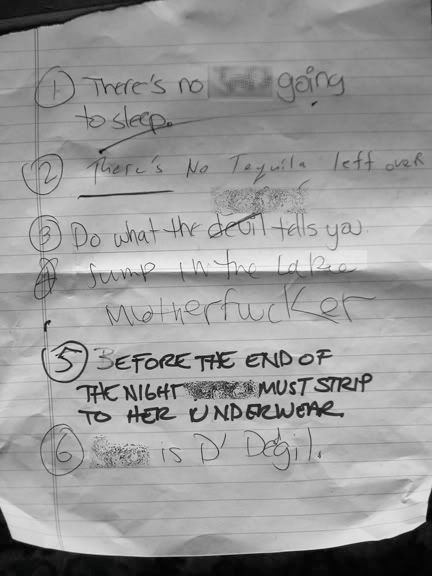
DRUNKEN POST WRITING AGENDA SCRAWLED OUT AT 4 A.M. (names were distorted to protect the guilty)

- Always remember the rules of good feedback: Be clear and specific. Be positive before negative. Be constructive and not merely judgmental. Offer solutions and not merely point out problems. Be respectful and sensitive to the goals of the filmmaker. Be brutally honest (again, but respectfully so). Do not interrupt other people's feedback. And, if you do, (because it happens when people are speaking passionately and ideas are flowing) make sure apologize/acknowledge and return to them when you are finished.

- Take copious notes. And/OR use an audio recorder. One of our participants had one built into his computer and created audio files for each project's feedback and then those files were given to the filmmaker. It was great.

And that, pretty much is that. Sounds simple, but it is amazing what goes on in those feedback sessions and in the subsequent discussions it creates throughout the retreat. And, with the right people of course, it is fun as hell....worth exponentially more than the price of admission. And the inspiration and ideas that emerged, at least for this filmmaker were (and are)...priceless.

Thursday, April 24, 2008

NAB 2008

So, Amanda and I trotted off the the annual geek-gathering in Vegas called the NAB (National Association of Broadcasters) Show, which has become (or always was) a media technology convention showing off the latest in media creation and delivery technology.

Some pretty cool stuff that is out there now or about to come down the runway. But why were these independent filmmakers there? Well, for a few reasons. Mostly, because Filmmakers Alliance has a handful of key, meaningful sponsors and they are all there at NAB. So, we need to check in with them. We are also launching our Global Initiative (turning FA into a global org via the web instead of the strictly L.A.-based org that it is now) and need the support of even more sponsors.

Secondly, most filmmakers are also geeks or have a geek inside them that wants to see all the cool stuff out there - and learn a little bit about how to use it. It's also useful to know, as an artist, what kind of colors I can add to my palette and what kind of brushes/new brushstrokes can I add to my work. And, also, what are the new ways I can bring my work to audiences. Truly, this stuff is very meaningful on a creative level....if a bit dry and boring sometimes.

Photobucket
AMANDA LOOKING THOROUGHLY OVERWHELMED ON THE EXHIBITS FLOOR (lots of men and too many "fart pockets")

Lastly, there is a filmmaking community tucked in with all the anxious businessmen and zealous geekosaureses. They flock here for the reasons mentioned above and we love connecting with them. A number of our FA cronies also show up, so it feels like a nice party and another opportunity to extend our filmmaking community.

Oh, and lets not forget it's in Vegas. Which, of course, pushes my buttons in terms of my love-hate with Vegas. Hate because I just think so much of it, and so much of who goes there, is flat-out disgusting. Some of the worse, most fucked-up human impulses find unbridled expression in Vegas. And the Vegas big-shots know it and thrive on it. "Sin City", "What happens in Vegas, stays in Vegas", etc. But despite that, I love it because I almost always have a blast. Granted, I know the tricks to keeping it fun. No more than twice a year (if that). No more than a couple of days at a time. Never gamble more than I can afford to lose. Never go to Vegas clubs (unless it is privately rented specifically for an event I have been invited to). Always mingle in non-Casino stuff like shows, bowling, hikes, dinners, etc.

Photobucket

CineVegas is an exception to these rules and is such a great festival because it has organized all of the Las Vegas vices into controlled activity built around a film festival. It's all of the fun without the sleaze and guilt. Well, maybe some sleaze. But just enough so that it easily washes off. And lots of good films. I highly recommend it.

Photobucket

Anyway, back to NAB. Two highlights: meeting up with one of our main sponsors - CANON USA and hanging out in the RED camera show booth.

We checked in with our CANON USA family. Tim Smith is now our main connect there (it had been the wonderful Mike Zorich for years). But there is also Greg Salmon and Cindy Baer (who is married to the brilliant D.P. Matthew Iriving - whom she often drags to the show) and many, many more. And we love Tim Smith. For what is essentially a corporate sales guy, he seems nothing like a corporate sales guy. He really understands filmmaking and filmmakers - understands and cares about them. Sometimes, listening to him talk, I feel like urging him to toss in the suit and tie and jump behind that camera. But I'm selfishly happy he's where he is because his and CANON's support for us means a lot.

Anyway, they've donated some HDV cameras to us for our members and to rent out cheaply to others, but are always checking to see if our needs are being met. They seem to be always looking to improve and address the demands of filmmakers. So, Tim arranged a meeting between us and CANON's Japanese engineers. They peppered us with creative and technical questions to get some idea of what filmmakers need and want. Apparently, they've had many meetings like this and seem to be really listening. We'll see what it births. It was fun, though, to get a small window into Japanese corporate culture and the strange, but endearing formality of it all. Well, it's endearing when you are only brushing up against it. Curious how Tim feels about it, being exposed to it on a regular basis.

Photobucket
CANON'S TIM SMITH, FILMMAKER DAWN WESTLAKE AND...SOME OTHER DUDE

Next, we spent time in the RED camera show booth. It was crowded and definitely attracted the more "hip" geekosaureses. Our friend Michael Cioni and his Plaster City Post crew were there en masse. Michael has quickly become a RED camera authority and has worked out some elegant post work-flow solutions for the camera. So, he was hosting demonstrations and answering questions on behalf of RED. We stopped in to say "hi" and he gave us a private tour. And I gotta say, any camera manufacturer searching for a way to address filmmaker's needs just has to look no further than this camera and tell themselves - I have to do this or better. We've used the camera on a few projects so far, and it is just awesome - for any price, let alone the relatively cheap one that it is now. And what they've got coming is only better, including a 5k camera, a small 3k camera and, essentially, a 2k drive/deck for tapeless projection for under $1000 dollars. Good stuff.

Photobucket
THE RED CAMERA EXHIBIT BOOTH

But while hanging out there, a guy came up and chatted with us very casually. I asked him if he was a "RED guy" and he kinda laughed and we continued talking about FA and the implementation of the RED camera in various kinds of projects. I asked who does marketing, as they would be good sponsors for us. He laughed again. Finally, I asked for his card. Turned out he was Jim Jannard, the founder of the RED camera and former founder-CEO of the Oakley eyewear and apparel company. I was immediately struck by his manner. He was easily the most down-to-earth and easy-going billionaire I ever chatted with. And I'm not just saying that because he is the only billionaire I ever chatted with. He also flirted a bit with Amanda, who had the good sense to ignore her hastily made and arbitrary rule of never flirting with billionaires. Amanda is a good gauge of character. If they respond to Amanda, they're usually good peeps. Most impressively, he seemed to really care about his camera and its impact on filmmakers. I should send him a follow-up email. Ya think?

Photobucket
JIM JANNARD'S BIZ CARD - A HEFTY, THREE-DIMENSIONAL WORK OF ART

Oh, two more highlights to add, actually. Winning $50 at craps playing on a table I had all to myself and bowling a 160 average when I was drunk off of my ass. Ah, the filmmaker's life....

Tuesday, April 22, 2008

AFI Dallas 2008

One of the perks of being around so long is that you attain a certain level of status by attrition (the survivor, the fixture, the dude that just won't give up and go away) and therefore you get invited to a lot of events as a juror, panelist, correspondent, industry expert, etc. And you eat it up for all the free booze, movies and meals it is worth.

You also get to meet a lot of people. And two of the lovelier people I have met over the years are Filmmaker-Producer-Festival Head Michael Cain and his beautiful wife Melina. Michael was tabbed as the CEO/Artistic Director of the new AFI Dallas when it launched two years ago after doing the Deep Ellum Film Festival for many years. And Melina provides the perfect compliment/partner - both in spirit and in roll-up-yer-sleeves work.
Photobucket

Anyway, they graciously invited me to the fest this year as a short film juror (along with filmmaker Harry Kellerman). Of course, I immediately agreed. Especially since I'd never been to Dallas. My only regret is that the trip would conflict with my annual sojourn to Ashland, Oregon for the Ashland Independent Film Festival. It is, itself, a great festival and I am honored to be a part of its family. But I had other objectives to address in the trip to Dallas, including drumming up financial support for FA's Global Initiative (and 5 Minute Film School).

My expectations were high because I've been part of the AFI Fest in Los Angeles and I'm very impressed with the quality of that festival. Also, with Michael and Melina involved, I knew, at the very least, it would be an enjoyable experience. The actual experience, however, exceeded my expectations.

From the quality of programming by Sarah Harris and James Faust to the quality of the actual screening presentations to the quality of lodgings at the W Dallas to the gracious Lexus-driving chauffers to the tightly planned/run events to the the army of committed, supportive volunteers, every aspect of the festival was top-notch as well as warm and supportive. Of course, that all comes from the top down, and as I said, Michael and Melina are great peeps. The peeps who oversee all the AFI film fests as well as directly manage AFI Los Angeles - Christian Gaines, Shaz Bennett and Rose Kuo - all rock, as well.

Photobucket
AFI DALLAS PROGRAMMER JAMES FAUST

Didn't get to see much of Dallas, beyond the official festival venues, but I did meet a few local filmmakers, Blair Rowan, Chris Gardner, Barak Epstein (makers of "Blood on the Highway"), their female lead Robin Gierhart and another local filmmaker Adam Donaghey. I pretty much hung with Blair, Chris and Adam throughout the fest and they were a drunken hoot - smart, fun and funny, but still responsible. Meaning, they were able to show up for work each morning after repeated nights of festival debauchery. They also had me laughing my ass off even when we weren't drinking. Bonding with these talented locals was definitely the highlight of the fest for me.

Photobucket
Blair Rowan, Me, Robin Gierhart and Chris Gardner
at "Blood On The Highway" after-party

So, of course, I had to see their film and I wasn't disappointed. It was all the hilarious mayhem that I'd hoped for - with raunchy dialogue so over-the-top as to be virtuosic. Hopefully, it will make it to AFI in Los Angeles and we can celebrate it with a raucous party. Check out the trailer for the movie HERE.

Photobucket

Finally, another of the best things about the fest was getting to watch 48 short films and discussing them with fellow juror Harry Kellerman. He's a smart, talented guy and a lot of fun so we were able to engage in some really thoughtful and inspiring conversations about the films....and not without a lot of humor. The programming was great, so the films almost always had some compelling elements to feed our discussions. In the end, the two that grabbed us the most both had, by sheer coincidence, a Dallas connection. Local filmmaker David Lowery's film "A Catalog of Anticipations" was an affecting, breathtaking fable to which we gave a Special Jury Prize. And we gave the Best Short Award to NY filmmaker, but Dallas native John Magary's "The Second Line" - a thoughtful, nuanced slice of post-Katrina that was a smart microcosm and metaphor for the kind of cultural and economic alienation that plagues too much of our otherwise robust country. It was truly a pleasure to meet, hang and discuss films with Harry and it all turned out to be among the best juror experiences I've ever had.

Photobucket
DALLAS IN MINIATURE AT THE TARGET FILMMAKER LOUNGE

I was impressed with the sophistication of the parts of Dallas I got to see. Saw a bit of old Seattle in the creative energy brewing there. Definitely great stuff going on so I look forward to heading back - if just to swap jokes with my new Blood On The Highway family. But I very much look forward to returning to the festival. Curious about how it will evolve and how much better it can get, because it is pretty damn good right now.